Friday, October 15, 2010

Adult Bald Eagle Admitted, Loon Making Progress, Many Calls on Injured Waterfowl


( Photo: Katie and Alberta tube feed the most recent Bald Eagle patient admitted from the Merrill area. )

We admitted an adult Bald Eagle with neurological signs. He is very low in weight coming in with a weight of just below 5 lbs. A typical male Bald Eagle weighs 8-9 lbs. Because he was so weak, we took a day to stabilize him before drawing blood for testing. He has an elevated blood Lead level. It is however not as high as I would expect to cause the extreme symptoms he exhibits. We began chelating treatments for lead but continue to look for other toxins that may also be present.


( Photo: Drawing blood from the adult Bald Eagle admitted suffering from neurological symptoms. He likely has ingested or was exposed to a toxin. Tests are underway to determine what toxin.)


A blog reader wrote to ask why many of our birds are starving when admitted when there is plenty of food in the environment. In the cases of a toxin, the bird is unable to eat. You can think of your own bodies reaction to eating something poisoned. If they are unable to eat due to toxin or unable to capture their own food due to a leg, wing fracture or other injury, the cycle of starvation begins. Some time can go by before the bird is captured and brought into REGI. The fact is by the time a wild bird can be captured, it has to be very weak. Starvation complicates the care needed, but is often part of the diagnosis.


( Photo: The Common Loon stretches her neck out underwater to grab a minnow!)

Our Common Loon is making progress. We are cautiously optimistic for her recovery. Aspergillosis is a fungal infection that can be a serious problem in loons and other avian species when they are physiologically stressed. She is treated twice a day with anti fungal oral medication to prevent aspergillosis.
Meanwhile she is swimming several times a day now and while still being tube fed emaciation diet she is also eating minnows ravenously on her own. Keep her in your thoughts as she has a long way to go.

Waterfowl hunting is underway in Wisconsin. We are receiving many calls about wounded Canada Geese and various species of ducks. Sadly, many of these game birds are injured and left to die a slow and painful death. If you find a goose or duck that needs help, please carefully put it in a cardboard box with a towel in the bottom and bring it to the REGI facility. We wish we could respond to every call, but our staff is small and the need great. We will take care of the birds once they arrive. Often the are able to recover.


( Photo: Alberta had a birthday on Tuesday! With the interns no longer with us, our group is significantly smaller, but still enthusiastic! We were happy Dave Koch, volunteer extraordinaire, was able to join us for the celebration. Dave has been working on the new eagle building. I will devote an entire blog to that effort and the great folks that helped Dave as well when we put the eagle in her new building.)

We have a busy day ahead. Hope your day is perfect!

Marge Gibson © 2010

Monday, October 11, 2010

Loon with Beak Wrapped with Fishing Line and Sinker, Volunteer Weekend


( Photo: This Common Loon, in immature plumage, was found on Sunday with fishing line wrapped around her beak, tongue and neck. Note the lead sinker attached to the line. People sometimes ask us how lead sinkers could possibly affect wildlife. This is how. The loon was unable to eat or even drink due to the position the line held her tongue, beak and neck.)

We had many wildlife calls this weekend. Sunday afternoon several people called about what they thought was a goose with broken legs on a local road. When they went back to check the "goose", it was gone. An hour later we got a call from the same area of a Great-blue Heron in a farmer's driveway. We left immediately to rescue the bird, whatever it might be. We arrived to find not a goose or a heron, but a Common Loon. She was in very difficult situation.

Fishing line was wound around her beak and neck. A lead sinker was visible on the side of her mouth. The fishing line was twisted around her tongue in such a way that she was unable to eat or even drink. The loon could open her mouth only 1/2 inch. To complicate matters, she had apparently had this problem for some time as she was near starvation.

We rushed her to the REGI clinic. My great staff had all the things we needed including wire cutters and electrolyte fluid ready when we drove up. We worked on the loon carefully to extricate her from the line. The tongue was wrapped tight. I worried about long term damage to her mouth. Gratefully, this morning she seems to be doing well. She has an uphill battle, however, to recover from starvation. We will work hard to make sure she has a future.

The young loon is still in critical condition. We have not done x-rays or blood work as she is too fragile at this point. I will keep you updated. F.Y.I. a person did not wrap this loon with the line. Unfortunately, when line is discarded in a lake or shore, wildlife find it and become entangled. Encourage fishermen you know to please discard their line responsibly. My grandchildren and I walk local lakes to collect discarded line. You would be amazed how much there is. It is a good activity to do with childen. They get exercise while learning about wildlife and being responsible people.


( Photo: Monofilment fishing line complete with lead sinker was removed from Common Loon patient #377-10 on Sunday.)


( Photo: Eating a few minnows on her own, our loon patient must be relieved to be able to open her mouth again. Feeding a starvation case is complicated. If given too much food, she could die. Most of this patient's food is an ematiation diet which she gets though a tube.)

We worked doing every outdoor project possible to keep ahead of the cold weather. Last year we had snow on this day! We know that could be our reality any day now. Once the weather hits freezing, we don't even see the ground until spring. It is a blanket of snow.

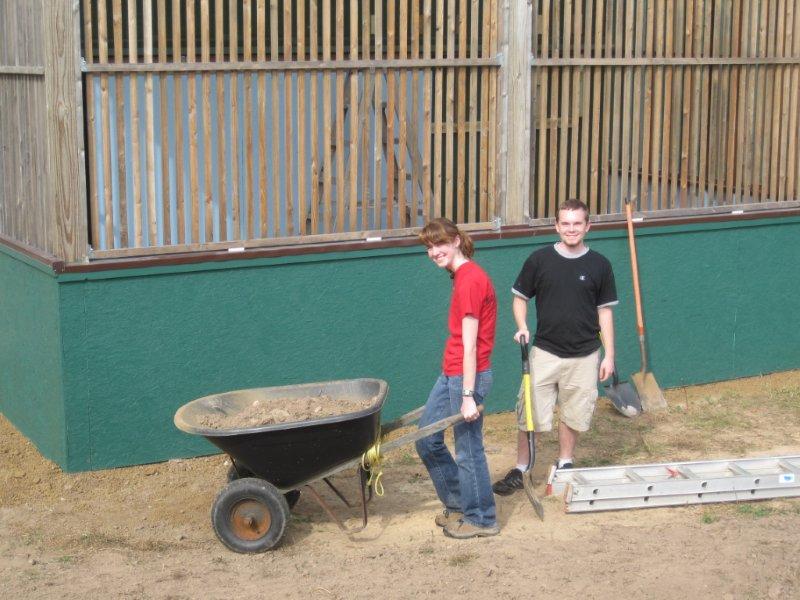
Thank goodness for volunteers Brandon Carmichael, Lenora Dombro, and Zack Zalewski! They worked hard all weekend along with REGI staff to get the facility ready for winter. We still have lots to do, but we can relax a little knowing the vital painting and moving soil, including some ditch digging, are finished.

People know we work with birds at REGI, but many have little idea of the manual labor involved in upkeep of the buildings and grounds in good shape. If any blog readers are carpenters or even know how to swing a hammer, we are always in need of cage repair.


( Photo: Zackary Zalewski and Robert Prinsen give the inside of the new eagle enclosure a second coat of paint to prepare for winter!. Thanks guys!)


( Photo: UWSP students Brandon Carmichael and Lenora Dombro volunteered all day on Sunday. They finished up the painting, then went right to hauling dirt and finally working with the birds. Thanks guys! )

Have a great day everyone!

Marge Gibson © 2010

Friday, October 8, 2010

Hermit Thrush and Merlin Admitted...Bald Eagle Chase Down

At REGI we are always well aware of what bird species is migrating through our area. While many people have birding reports to rely on, we actually have the "bird in the hand" so to speak.


( This Hermit Thrush was hit by a car. They are migrating at this time to a warmer climate. This bird, however, will miss fall migration this year. It will stay at REGI as it recovers from a head injury. )

Merlins are on the move as well. Small but powerful falcons, Merlins dive or "stoop" at a high rate of speed. Our newest Merlin patient is a female. She is a big strapping lady bird with a wing injury. I never tire of experiencing what can only be described as their exuberance for life while they are captive. While some species are patient patients, Merlins do not fit that description.


( This female Merlin likely hit a guy wire and injured her wing. This is a common injury for this speedy little falcon. )

We had a busy day "chasing eagles" on Wednesday. We had 5 Bald Eagles in the large eagle conditioning flight. It was time to catch up each of them to evaluate their release readiness. In the end, over an hour later, Katie, Alberta and I were all huffing and puffing, and one of the birds was still happily avoiding capture. He is the epitome of being well-conditioned.

We were too exhausted to take photos of this event. But, trust me, it was very cool!

The weather has been nothing short of gorgeous this week. I love the change of the seasons. Fall is beautiful with the brightly colored leaves. It is also, however, a warning that winter will be upon us before we know it. We are making the most of preparing for the inevitable.


( Photo: One of the beautiful maple trees in full color on REGI property.)

We will be working until the snow flies getting painting done, winterizing the mews and enclosures, and doing repairs to existing buildings. If you have some time, give a call and come on over to lend a hand. I promise, you will be warmly greeted and will definitely feel needed. You can reach Molly at 715-623-2563 or the clinic at 715-623-4015 if you want to volunteer some time.


( Photo: Lance doing some "up high" painting on Thursday. )

Have a great day everyone.
Marge Gibson

Monday, October 4, 2010

Raptor Education Group, Inc (REGI) Birds Featured in Wisconsin Trails Magazine


Hello Everyone,

We are happy and excited to announce that several of our education birds are featured in the most recent issue (Oct 2010) of Wisconsin Trails magazine. Wisconsin Trails is a well-respected magazine in our state, which makes the honor all the more pertinent. We hope you enjoy it as much as we do! As an additional bonus, a photo of one of our favorite resident chickens appears on the back page. While the story is unrelated to her personally, it is an honor to have this special little lady showcased.

The photo above of our red-phase Screech Owl is just one of those you will see. Photographer Jerry Luterman did a fantastic job not only of photographing our birds but also being sensitive to their needs and ours during the process. I am a stickler when it comes to the well being of our birds. Keeping me happy means the photo session had to be stress-free and uncompromising for the birds. That can be a challenge for photographers.:)

Fall has arrived! The brightly colored leaves of the Maple and Oak trees are spectacular in our region now. Migration is ongoing, but many species have already left Wisconsin for warmer climates. Last night we had a hard frost with the temperature dipping to a chilly 23 degrees F. or -6.7 degrees C.

The clinic is full of patients, so stay tuned to the next blog.

Happy fall everyone,

Marge Gibson

Friday, September 3, 2010

The summer is winding down

Wow! What a summer it has been! It seems like only yesterday our interns were arriving. Fresh, full of enthusiasm and eager to learn. We were lucky to have gotten an amazing crew of interns this year. The summer was full of learning experiences for them. (Above: Summer interns left to right, Karissa Mohr, Katie Rymer, Robert Prinsen and Jennifer Rothe, pose before their first release of the summer. The interns were all able to participate in the release of many patients after this one.)
Our last intern left earlier this week. They are all headed of either back to school, or on to their next wildlife jobs.
We had out usual influx of babies, and we all enjoyed watching them grow from little balls of fluff into beautiful feathered birds. (Quite rapidly, I might add.) Many of our summer babies have already returned to the wild to live what we hope will be a full life. A few others just were not healthy enough to be released.Let me introduce you to some of our summer babies.3 Northern Harriers came in this year (Above: top photo). Northern Harriers are also called Marsh Hawks and are ground nesters. When farmers mow early in the year they will often mow down nests. This farmer stopped to pick up the babies and brought them in to REGI. 2 of the 3 were healthy and active from the start. Those 2 are just about ready for release. Unfortunately their sister was very sickly for the first few weeks. She was just not as quick about getting food, her eyes were crusted shut for a long time and she appears to have some serious developmental disabilities. We really did not think she would pull through. But, she did! She has a great future in education ahead of her. (Above: lower photo.)Another new member of our education team is Jack, the Prairie/Gyrfalcon hybrid. Jack was bread in captivity for falconry. When he was just a little ball of fluff he had an ingrown eye lash that got severely infected. He wound up completely losing his eye. The falconer called us up to see if we needed another education falcon. (Above photos: [top] Jack when he just arrived at REGI. You can see from his bulbous crop that he just had a big meal. [bottom] Jack is now in full feathers and very beautiful.)We had a rare patient this summer, a beautiful Long Eared Owl. When he came in he was in bad, bad shape. The poor little guy was convulsing and had a well defined injury to his head. Our intern Karissa was transporting him from her hometown to REGI and called to tell us that she was pretty sure he wouldn't even make the trip. Long Eared Owl chicks are known for leaving the nest to sit on tree branches before they can even fly. If they fall from the tree they may become injured on the way down or be injured by a predator after leaving the safety of their nest. It seems that is exactly what happened to our little owl. We suspect that a dog got to him. After all of that intensive care he received in recovery he also has become imprinted on humans.
One of our babies that is on the road to freedom is a baby Turkey Vulture. He came in orphaned but was teamed up with some foster parents. Since he is healthy and the fostering kept him from imprinting he will be released soon. He has already shown us that he is a first class flier. (Above: [top] Baby Turkey Vulture with one of his foster parents, [bottom] Although his adult plumage is in you can tell he is a juvenile by his black face.)
Some of our patients come a long way to be cared for. A set of baby Trumpeter Swans came all the way from Minnesota after they had been orphaned. Trumpeter Swans were very recently removed from the endangered species list. There are few facilities that care for them. Luckily REGI is one of them. (Above: [top] cygnets shortly after arrival exercising in the tub, [bottom] the cygnets are turning to the gray color that juveniles have and spending time with an adult trumpeter who lives here at REGI.)We also had a group of American Kestrel chicks come in. The tree that their nest was in had been cut down. Luckily we found them foster homes in active Kestrel nest boxes where they were adopted into new families. The interns got to work along with a bander to record and band them before placement. (Above: [top to bottom] 4 American Kestrel Chicks when they arrived at REGI, Putting a leg band on, Weighing before the release and Karissa places one of the Kestrels into a nest box).

Molly McKay
Education Coordinator

Wednesday, August 18, 2010

REGI Patient Releases


Above: Interns Katie R. and Karissa release another of our Broad-winged Hawk patients

One of our favorite activities at REGI is to release a fully rehabilitated bird, giving it a second chance to live in its wild habitat. Sometimes, our releases are publicized and attended by many members of the public, who get to see a Bald Eagle return to its home territory, or a large owl fly off into the night, or a Trumpeter Swan, completely free of the lead poisoning that almost killed it, rejoin its family on the water. Sometimes, we release fully rehabilitated birds at or near our REGI facility, as the surrounding area offers ideal habitat for them. And sometimes, a release is a quiet, private celebration, as was the recent release of a Broad-winged Hawk that I had the honor of performing.

The hawk had been thoroughly checked over one final time by our rehabilitation team, and it had been fed generously, so it would be full when released and would not have search for food immediately in its new situation. The bird had been picked up injured in eastern Marathon County, so I headed to a suitable place not far from where it had been found. I checked the surrounding area, satisfied that the habitat was appropriate for, and would likely be familiar to, this handsome hawk. I stopped the vehicle in a quiet place. I carefully lifted the box out of the front floor where the hawk had taken its last (I very much hope) ride in a car. I placed the box on the ground, letting the hawk settle a bit after moving it from my vehicle. We both listened to the sounds of the woods nearby.

I slowly opened part of the top, allowing the hawk to see up and out a few moments, then opened the box completely. We sometimes joke that it would be nice if each bird, as it is released, turns slowly back, as if in a Hollywood movie with music swelling in the background, and tips its wing in a kind of "movie-romantic" thank-you wave. In reality, the bird typically just takes off, heading in the direction it wants, and doesn't look back. Just so with this hawk. A confident jump to the rim of the box and it was gone in a flash, flying strongly and with seeming purpose toward and into the woods close to the release site. I caught one fleeting glimpse of the hawk, a confident, healthy, speeding blur headed for a new life. I stood for a few minutes, taking in the surrounding sounds and scenery, and returned to my car. A brief, silent, solitary experience shared with a beautiful raptor...a memory that, for me, will last much, much longer.

Steve Fisher
REGI Education Director

Monday, July 26, 2010

Wings in Wausau Event this Saturday!


We have the greatest volunteers here at REGI! One of our old interns, Megan Ackley, has come back to help REGI with a big project. She has organized a series of fund-raising events in Wausau, WI. The first of these is Wings in Wausau, this Saturday, July 31.

Please come and join us at this FREE family event. And tell your friends!

WINGS IN WAUSAU

Date: Saturday July 31, 2010
Time: 10:00am - 2:00pm
Where: Northcentral Technical College
1000 West Campus Drive
Wausau, WI 54401
Cost: FREE!


Join us for this family friendly event. Featuring some of REGI's live raptors at bird education stations, a silent auction, vendors, activities and more! The REGI staff will be there joined by some of our dedicated volunteers to share these magnificent winged wonders.

So come on in and join us, learn about raptors, some of the issues that they face and look a few right in the eye.

If you have any questions contact:
Megan Ackley
Raptor Education Group, Inc.
Volunteer Fundraising Coordinator
715.252.6737
ackleymm@gmail.com